

September Colorado Fall Foliage Report 2026: When and Where to See the Best Colors
Updated September 11, 2026
Colorado’s annual transformation has begun. The first hints of yellow are appearing in the high country, and this year, leaf-peeping season may be arriving a little earlier than usual.
Colorado Department of Transportation, citing Colorado State Forest Service experts, says drought and prolonged moisture stress could push fall color ahead of its typical schedule in some areas. Northern mountains and high passes above 9,500 feet are expected to lead the transition in early to mid-September, followed by the central mountains later this month and the Front Range into late September and early October.
That means September 11 is still early for much of Colorado — but the window is opening quickly.
2026 Fall Color Forecast at a Glance
Area | Conditions Around Sept. 10 | Best Estimated Window | Our Take |
Boulder | 🟢 Mostly green at lower elevations | Sept. 27–Oct. 20 in town | Head uphill for earlier color |
Denver | 🟢 Mostly green | October–mid-November in the city | Plenty of time |
Rocky Mountain National Park | 🟡 Transition beginning at elevation | Sept. 13–24 | Next up |
Summit County | 🟡 Early hints/high elevations first | Sept. 16–28 | About to get good |
These dates are estimates rather than guarantees. Elevation, temperature, moisture, wind and individual tree health can shift color considerably from one drainage—or even one hillside—to another.
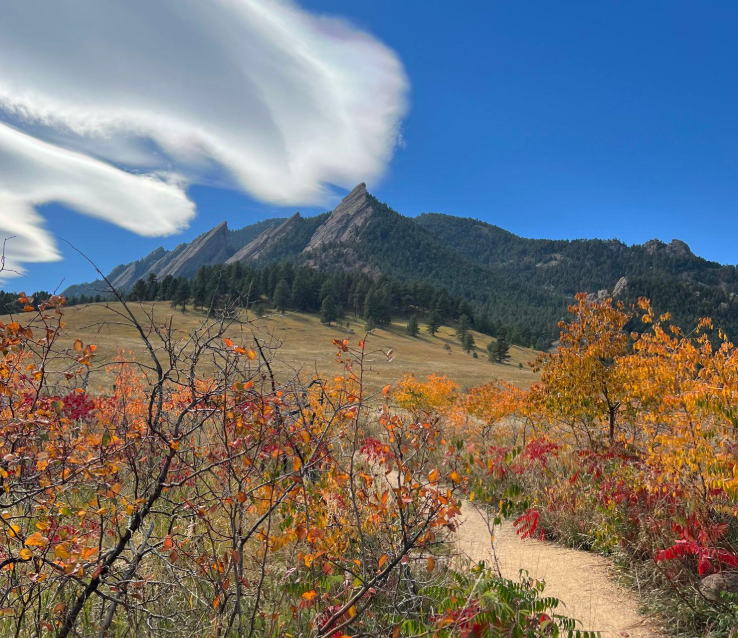
Boulder: Still Green in Town, But Look West

If Boulder looks more like summer than fall right now, that's normal. September 11 is generally too early for peak foliage within the city itself.
Visit Boulder puts the area's typical foliage window at September 27 through October 25, with October 5–20 generally offering the best color in town. That's when Boulder's cottonwoods turn yellow, maples bring in shades of red and the foothills take on their autumn palette.
But there's an important distinction between Boulder and the mountains west of Boulder.
Elevation speeds things up dramatically. The 2026 forecast puts the Peak to Peak Highway and mountains west of Boulder in roughly the September 13–24 window.
Where we'd look right now: Nederland and the higher reaches west of town are better bets than downtown Boulder. Over the next week or two, the Peak to Peak Scenic Byway should become one of the Front Range's best options. Visit Boulder specifically recommends the byway in mid- to late September for its roadside aspen stands.
Best bet: Wait another week for the mountains; wait until October for Boulder proper.
Denver: Summer Green Is Hanging On

Denver is playing the long game.
Because the city sits at a much lower elevation than Colorado's mountain destinations, Denver's urban canopy changes considerably later than the high country. Visit Denver notes that the region's varying elevations create an unusually long leaf-peeping season: high-elevation aspens begin changing in mid-September, while foliage eventually reaches the foothills and plains from October into mid-November.
So if you're looking around Denver this week wondering where fall went, you haven't missed it. It largely hasn't arrived yet.
When it does, Denver offers a different type of fall display. Instead of mountainsides covered in aspen, expect mature cottonwoods and other deciduous trees to turn along the city's parks, waterways and neighborhoods.
Washington Park, City Park, Sloan's Lake and the cottonwood-lined High Line Canal are all good choices later in the season.
Best bet: Save Denver leaf-peeping for October. If you're itching for fall now, drive west and gain elevation.
Rocky Mountain National Park: The Foliage Show Is About to Start
Here's where things start getting interesting.
The current 2026 forecast places Rocky Mountain National Park and the Peak to Peak corridor around September 13–24, putting September 10 right on the doorstep of the expected prime viewing period.
There's a reason Rocky changes before Boulder and Denver.
According to the National Park Service, color in the park historically begins in the subalpine zone at roughly 9,000–11,000 feet in early September, then progresses into the lower montane zone as the month continues.
That creates a useful strategy for September visitors: follow the elevation.
Higher portions of the park can show fall signs while lower valleys remain predominantly green. As September progresses, that band of color moves downhill.
On the west side of the park, the Kawuneeche Valley provides another interesting progression: high-alpine tundra develops deep reds and purples while lower-elevation aspens and cottonwoods transition toward gold and orange.
And the leaves aren't the only reason to visit. September also marks the beginning of elk rut, bringing the unmistakable sound of bugling elk to the park's valleys.
Best bet: Start watching RMNP now. The next two weeks should be one of the strongest windows of the season, particularly around higher aspen stands.
Summit County: Gold Is Coming Fast

Summit County is another area to have on your radar right now, even if we're not quite at peak.
The current 2026 forecast estimates September 16–28 as the primary window for Summit County and Colorado's central mountains. That's also consistent with CDOT's broader outlook, which expects central mountain locations around 8,000–9,500 feet to peak from mid- to late September.
A Summit County foliage update published September 8 notes that the higher elevations change first, followed by lower elevations, creating several weeks when visitors can usually find color somewhere in the county.
Around Breckenridge, the historically strongest window stretches from mid-September into early October, with the last two weeks of September often being the sweet spot.
For a scenic drive, Boreas Pass is hard to beat, winding through extensive aspen stands above Breckenridge. Swan Mountain Road and Sapphire Point offer views across Dillon Reservoir, while French Gulch combines aspen groves with remnants of the area's mining history.
Elsewhere in Summit County, the Dillon Reservoir, Frisco and Silverthorne area is surrounded by aspen stands, with an 18-mile paved recreation path around the reservoir providing another way to see the changing landscape without spending the entire day in a car.
Best bet: Give it about a week. From roughly September 16 onward, Summit County should become one of the stronger choices on this list.
Why 2026 Could Look a Little Different
Colorado Public Radio reported September 9 that Colorado State Forest Service aerial surveys are already seeing patches of yellow and orange, but some of that early color appears to be caused by drought stress rather than the normal seasonal transition. State Forest Service entomologist Dan West said drought effects are currently responsible for more of the early change they're observing than the typical autumn transition.
That matters because an early yellow tree isn't necessarily an indication that an entire area is approaching peak.
The Colorado State Forest Service explains that fall color depends on a combination of shortening daylight, elevation, latitude, weather, moisture and overall tree health. Healthy aspens are generally better able to produce vibrant colors and hold their leaves longer.
In other words, don't expect Colorado to flip from green to gold all at once.
So, Where Should You Go This Weekend?
As of September 10, don't chase peak color in Denver yet.
Instead, start high.
Rocky Mountain National Park and the higher elevations along the Peak to Peak corridor are entering their expected color window first. Summit County should follow closely behind, particularly beginning around September 16. Boulder will gradually light up from the mountains toward town, while Denver should provide some of the latest color of the four areas.
And remember: peak foliage is fleeting. Colorado.com notes that peak color can last only about a week in many locations, which is why flexibility can make the difference between finding a hillside of green aspens and one glowing gold.
For 2026, our advice is simple: start high, follow the color downhill, and don't wait for every forecast to say "peak."
The mountains are already starting to change.
Sources: Colorado State Forest Service, Colorado Department of Transportation, National Park Service, Visit Boulder, Visit Denver, Colorado.com and current Colorado reporting. All foliage windows are estimates and conditions can change rapidly with temperature, wind, precipitation and elevation.


